Climatological Limits to Livestock: A Plea for Plant-Based Diets
by Keith Akers
There isn’t any specific scientific consensus on the precise impact of livestock on the climate. It is a contentious issue, partly because it’s so difficult to measure. We can say, however, that the impact is likely colossal.
Moving towards plant-based diets will not, by itself, solve the climate problem. We still need to end our reliance on fossil fuels. However, it is necessary to solve the climate problem.
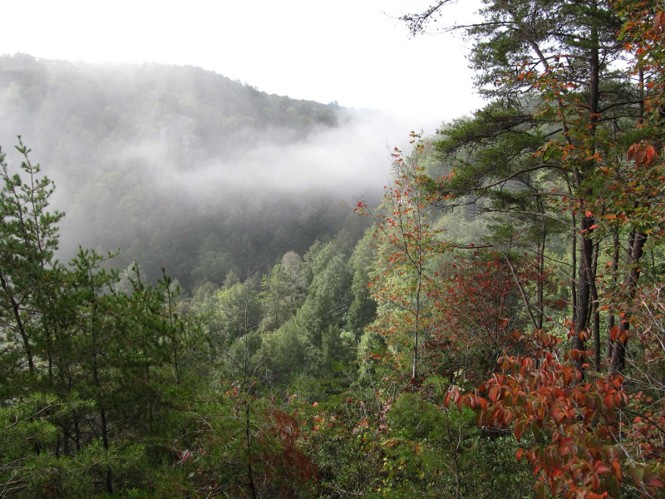
European settlers cleared forests like this for pasture and hay fields, now open meadows in today’s Great Smoky Mountains National Park. (Keith Akers)
Of course, just because something is “unsustainable” doesn’t mean we can’t do it anyway! Long before it becomes physically impossible to raise more cattle, though, we encounter increasingly unpleasant consequences, such as soil erosion, groundwater depletion, and rising medical costs. Halting the runaway consequences of livestock agriculture requires a sustainable, steady state economy, encompassing sustainable scale in the livestock industry along with all other sectors.
But let’s focus on one particularly nasty consequence of livestock production: climate change. The scientific community overwhelmingly acknowledges the reality and urgency of climate change. The American public also acknowledges it, though less overwhelmingly.
However, there is much less discourse—scientific or public—about livestock’s contribution to the problem. It is a contentious topic for complex reasons. And while mainstream science focuses almost exclusively on direct emissions from livestock production, there may be more to the livestock-climate story.
A Complex Problem
A key reason livestock’s impact on the climate is hotly debated is that it is difficult to assess land-use impact.
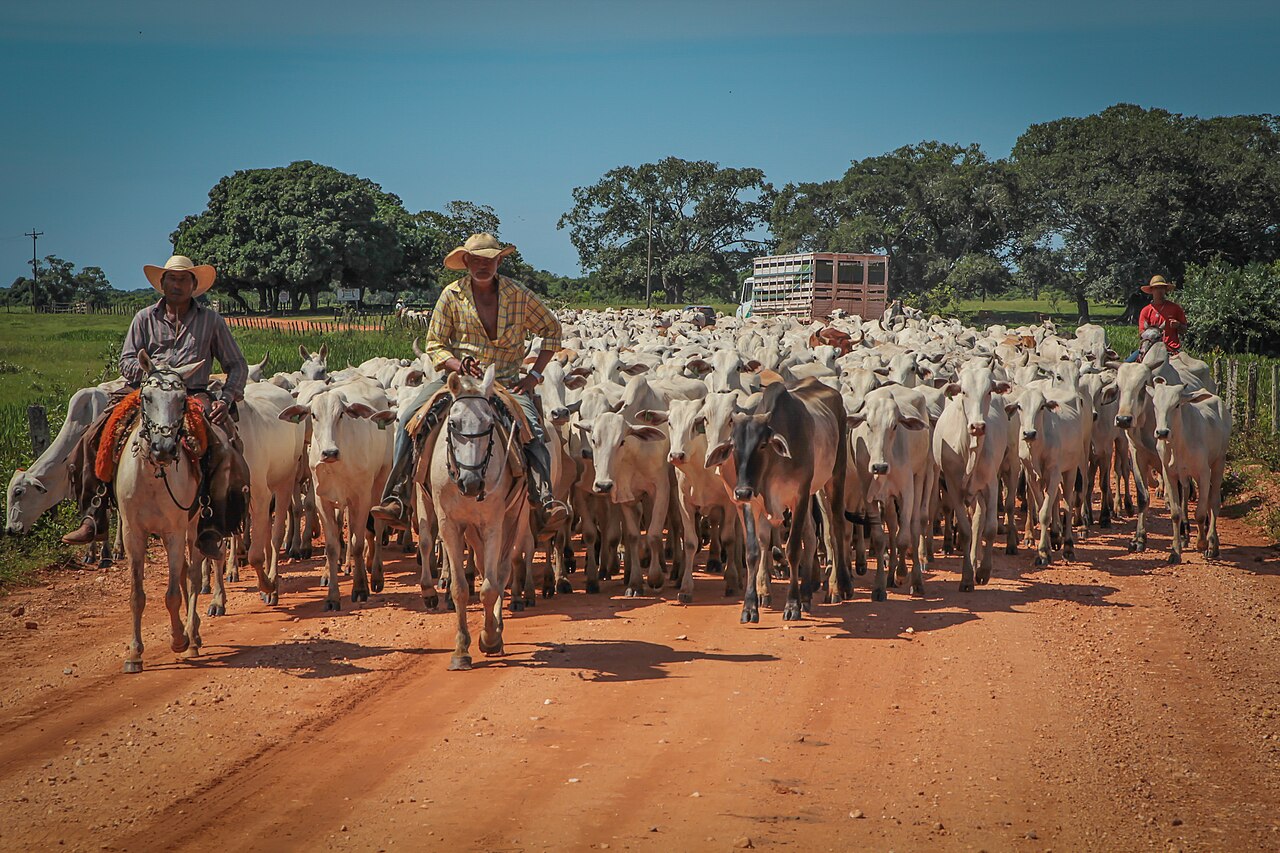
The main human use of land is for agriculture. Agriculture dwarfs urban development, roads, and buildings in the sheer area of land involved. And of that land, about 80 percent is for livestock production. So if we’re talking about land use, for the most part we’re talking about livestock.
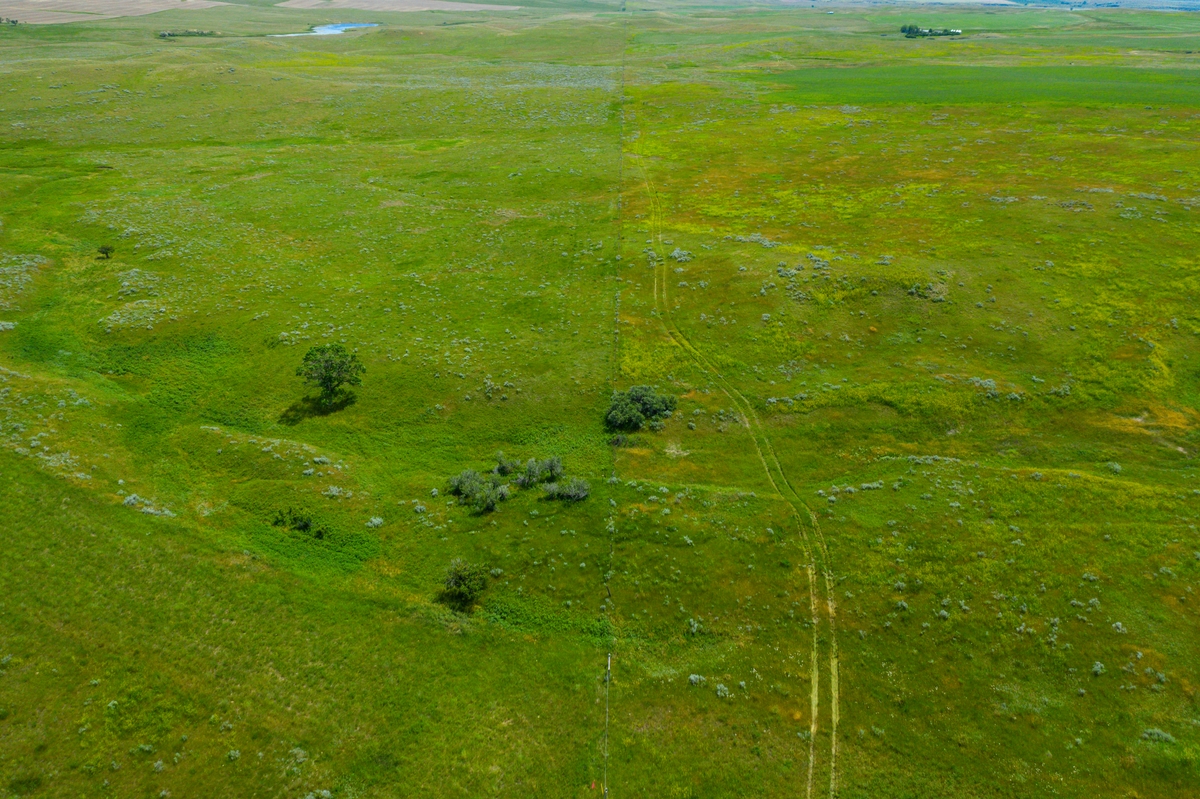
We use 30 percent of Earth’s habitable land to graze livestock. (Flickr, Public Domain)
Land use affects the number and type of plants and animals, and plants and animals are key factors in the natural carbon cycle. Plants absorb carbon dioxide (CO2), and animals respire CO2. Due to human land use, plants are decreasing, and animals are increasing, in terms of biomass. This creates an imbalance that impacts the amount of CO2 in the atmosphere.
To measure these impacts, scientists are turning to the relatively new concept of “carbon opportunity cost.” In the livestock-production context, this refers to the additional carbon the land and its vegetation would absorb if not converted to grazing land or cropland for livestock feed. This concept can also be applied to cropland used to feed humans directly. This would enable comparison between the carbon opportunity cost of producing the same number of calories or grams of protein via animal- versus plant-based foods. Such analyses get complex quickly, especially when one considers the drastic regional differences in livestock and crop productivity.
A Contentious Problem
Methane is another complex and contentious factor regarding livestock production’s impact on the climate. Agriculture is the single largest anthropogenic source of methane, and most of that is from livestock. But there is no agreement on the best way to assess methane’s impact.
Methane has a much greater impact than CO2 in terms of its warming potential, but it also breaks down fairly quickly in the atmosphere. The net impact depends on the time frame we choose, and scientists and policymakers have not agreed on what time frame is most appropriate.
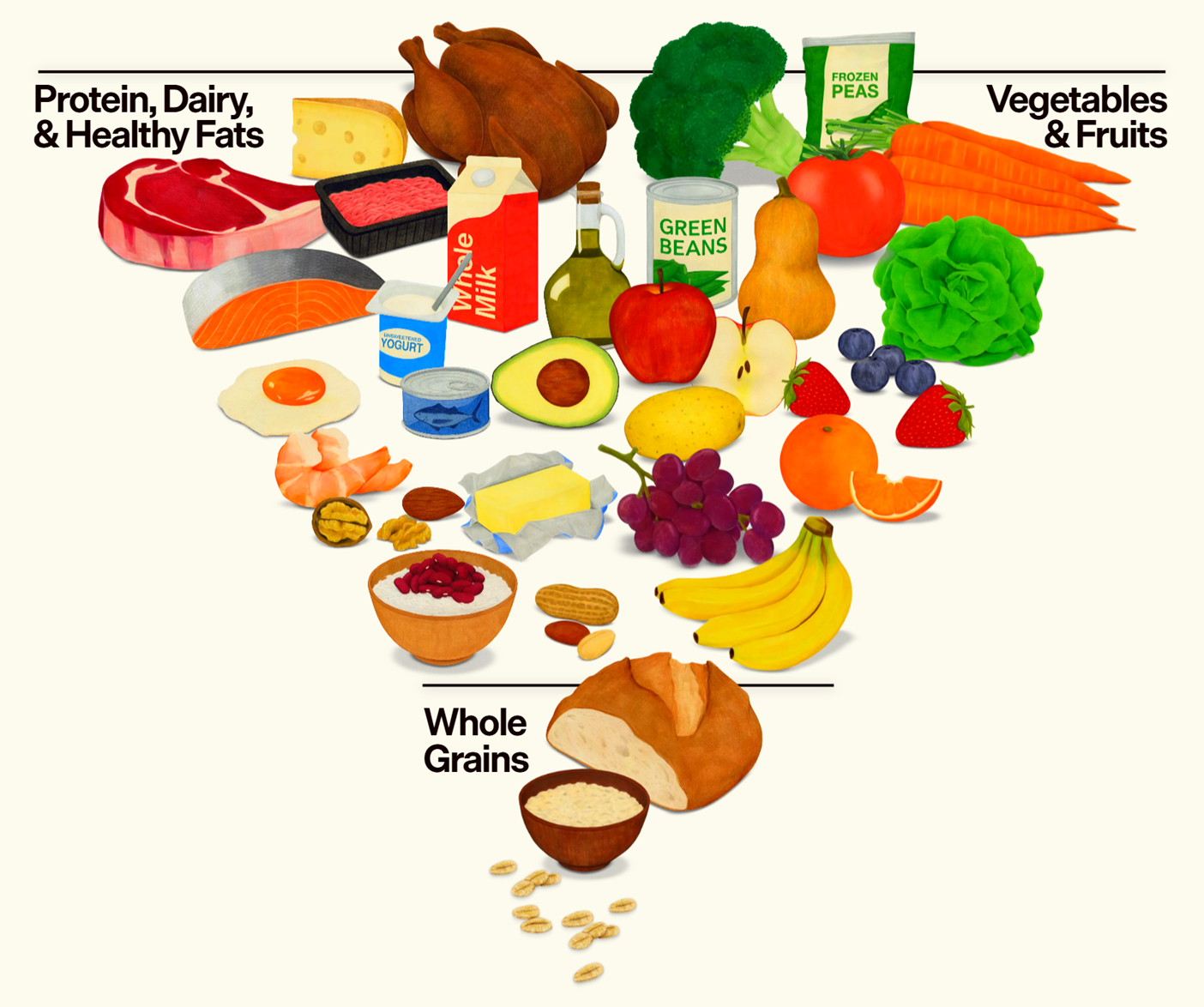
If the Trump Administration’s new food pyramid is any indicator, U.S. research on food and agriculture continues to suffer from corporate capture. (RealFood.gov, Public Domain)
Finally…politics. The Food and Agriculture Organization (FAO) of the United Nations is influenced, if not effectively controlled, by the livestock industry. In 2012 they announced an official partnership with the meat and dairy industries.
Even basic data like the number of cows is often contested. In the early 2000s, many non-governmental organizations reported double the number of cattle that the FAO did. Even the FAO’s own data on poultry production differs from report to report by a factor of two. Their April 2003 Food Outlook puts the amount of poultry produced in 2002 at 72.9 million metric tons, while Livestock’s Long Shadow provides a figure of 33.0 million metric tons.
President Trump has exacerbated the problem with his attacks on scientific research, but the lack of solid livestock data pre-dates the Trump Administration by decades.
What’s with the Carbon Cycle?
To untangle the complexity surrounding land use, an overview of the short-term carbon cycle helps.
CO2 is circulating into and out of the atmosphere due to natural processes. Most emissions are not human-caused; anthropogenic CO2 emissions amount to only three percent of the emissions from natural sources. This is not three percent of CO2 in the atmosphere, but an extra three percent of CO2 emissions. In the natural world, carbon sources (such as decaying organic matter and animal respiration) are roughly counter-balanced by carbon sinks (soils, oceans, and photosynthesis).
Photosynthesis—through which (among other things) plants absorb CO2 from the atmosphere and emit oxygen—is a key process in the short-term carbon cycle. When plants die, microbes in the soil consume them and release CO2 back into the atmosphere. However, some of the carbon from plant matter is stabilized in the soil, as well, for long-term storage.
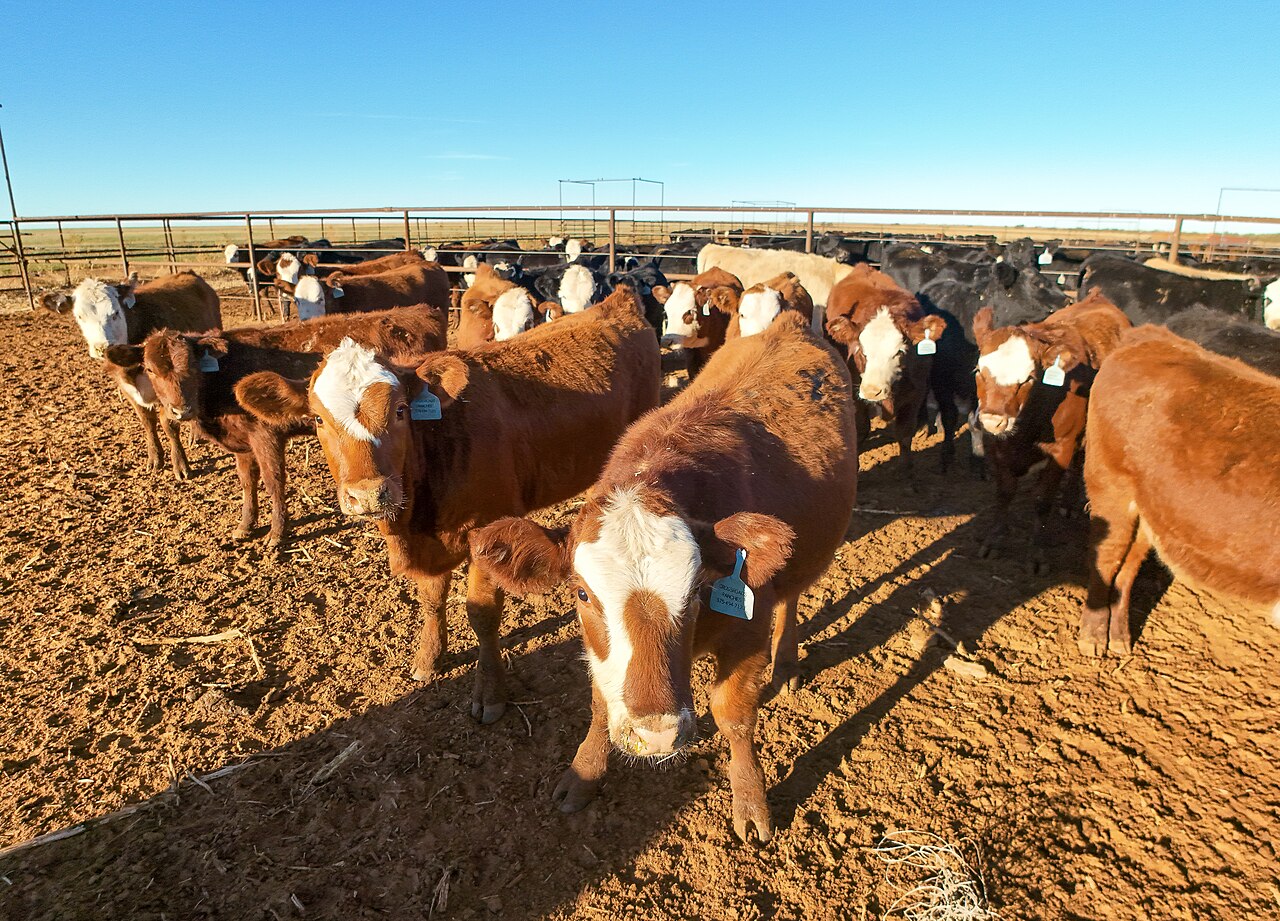
Beef cattle in a feedlot in New Mexico, United States. Not a lot of photosynthesis going on here. (Quintin Soloviev, CC0 1.0)
Earth’s soils hold more carbon than its atmosphere and vegetation combined. Oceans are also key in the short-term carbon cycle. They are currently massive carbon sinks, but their ability to absorb CO2 is limited.
Historically, these processes—photosynthesis, decay, respiration, and absorption and emissions from oceans—have typically balanced each other out. There are also long-term carbon cycles. The ice-age cycle, and the even longer-term geological carbon cycle, can last hundreds of thousands or millions of years. For our purposes, we can ignore these. (For the very long-term thinkers: Watch out for that next ice age.)
Carbon Opportunity Cost
The most obvious way to disrupt the short-term carbon cycle is to put extra CO2 into the atmosphere, such as by burning fossil fuels. But a different way is to reduce the amount of photosynthesis. Let’s consider the very real example of someone burning the Amazon rainforest to create grazing land in Brazil. The direct CO2 emissions can be considerable.
Over 60 percent of the Amazon area deforested from 1988 to 2014 is used to raise cattle. (Vicente Bissoni Neto, CC BY-SA 4.0)
But the burning itself is a one-time event. What about next year? Left to itself, in many cases the forest would begin to regrow, drawing CO2 out of the air and incorporating the carbon into tree growth. But in this case, cattle grazing obstructs reforestation.
Of course, plants still grow on pastureland. Forests may have immense carbon-storage capacity, but how do their rates of ongoing carbon sequestration compare with grazing lands? It depends. Grasslands with deep root systems can be powerful sequesterers, and cattle grazing can degrade or augment that power, depending on management practices.
In our Brazilian-Amazon example, the grazing land would almost certainly have a lower rate of carbon sequestration than the forest it replaced. That’s because the Brazilian Amazon biome has the highest carbon sequestration potential of all the world’s forests. It is also one of the world’s most deforested biomes, currently, though forests have long been victims of economic activity.
Humans have reduced the number of trees on Earth by almost half. Yet, forests still constitute 80 to 90 percent of Earth’s plant biomass. Though difficult to measure across varying habitats and management practices, the impact of replacing these invaluable carbon sinks with pastureland could be immense.
And yet, forests aren’t the only ecosystems being converted into grazing land. Likely due in part to the attention forests receive, natural grasslands and wetlands are being lost to agriculture at a rate four times higher than forests. Over half of this conversion has been to raise livestock or their feed. This phenomenon is happening on such a large scale, that it would be foolish not to seek to better understand its carbon opportunity cost.
More Animals, Fewer Plants
Even before trying to estimate carbon opportunity costs, there are two reasons to believe it’s quite big: Large mammal biomass (and total animal biomass) is substantially increasing, and plant biomass is crashing. This is despite declines in populations of wild large animals, or megafauna.
North America provides a tragic example of these declines. The American bison population plummeted from 60 million in the 1850s to only a few thousand in the 1880s. Globally, elephant (carbon) biomass declined an estimated 90 percent in the 20th century. 70 percent of the world’s wild megafauna species are declining in numbers.
But increases in humans and our livestock have far outstripped decreases in wild megafauna. Cattle (carbon) biomass increased 250 percent in the 20th century. In 2000, humans and our domesticated animals constituted an incredible 97 percent of all terrestrial animal (including human) biomass. And about two-thirds of large-animal biomass is livestock, which has about double the mass of the human population! The large animals on Earth are now mostly cows and people.
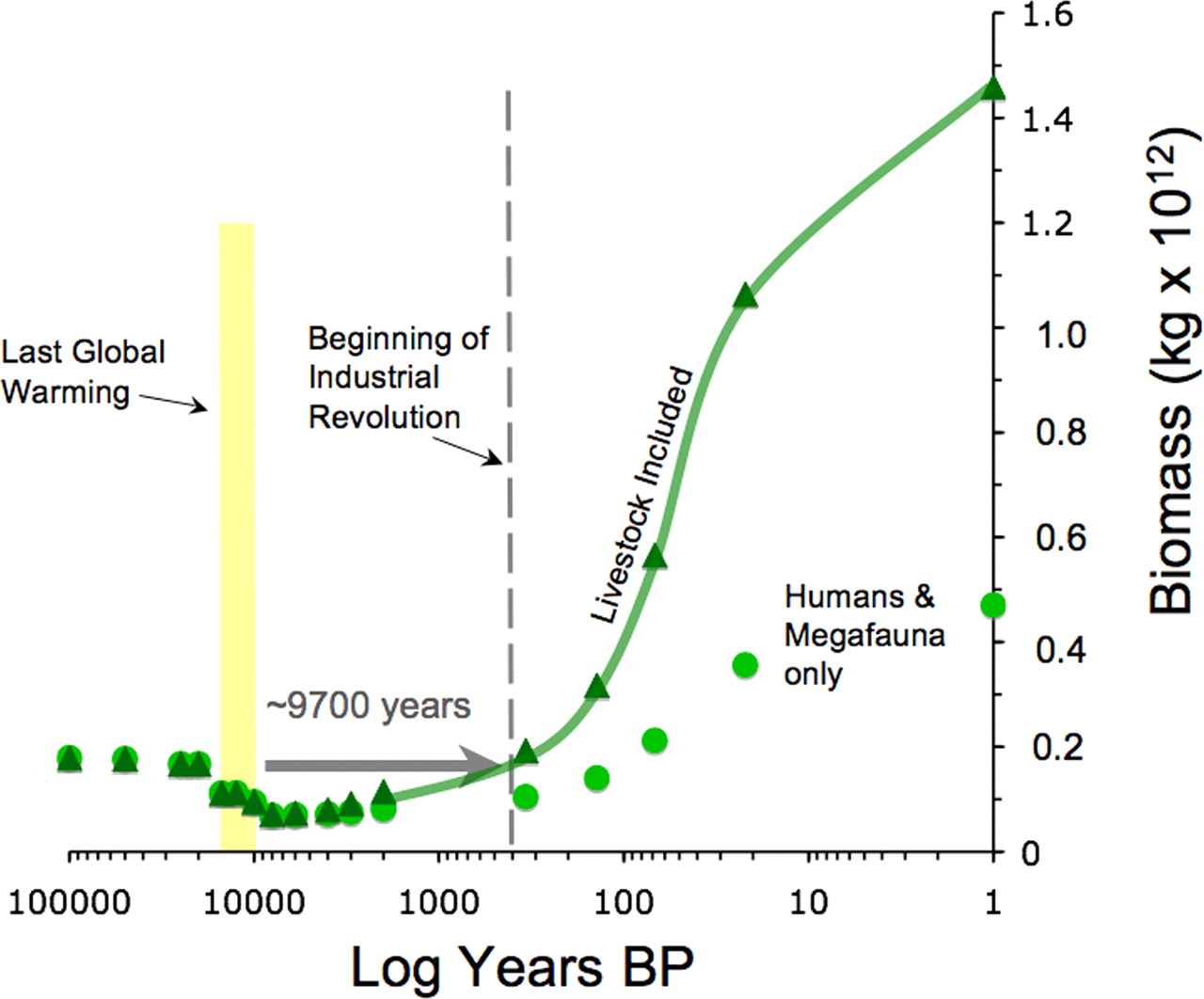
Estimates of total biomass (as opposed to carbon biomass) by UC Berkeley researcher Anthony Barnosky. BP stands for before present. (Proceedings of the National Academy of Sciences USA 105 (Supp. 1): 11543-11548. Copyright 2008.)
As bad as the increase in animal biomass—and resultant increase in respired CO2—is, it’s gone hand in hand with another, perhaps more alarming, biological problem. In a “full world,” more land dedicated to animals means less available for plants. Phytomass (plant biomass) has dramatically declined under human influence. Vaclav Smil at the University of Manitoba estimates it has declined by half in the last 5,000 years.
This is corroborated by a more recent study. Researchers estimated that, without human influence, Earth would contain 916 billion metric tons of plant matter. In reality, it only contains 450 billion. How do you think the destruction of half of Earth’s plant life might impact photosynthesis and, in turn, CO2 levels?
To be clear, not all of this plant destruction has been for the sake of livestock production. But recall that agriculture dwarfs other human land uses and livestock production dwarfs other agricultural land uses. Sure, producing less in animal products would mean producing more in plant products for human consumption. But it takes an estimated 50 to 100 times more land to produce a gram of protein from beef compared to peas or tofu.
Of course, not all land is suitable for crops. But when some researchers say plant-based diets could cut agricultural land use by 75 percent, it’s time to rethink how we’re using Earth’s carbon sequestration potential.
Measuring the Impact
We have good reason to believe the climate impact of expanding animal biomass and decreasing plant matter is large. Yet some experts steadfastly ignore the idea of carbon opportunity cost. The FAO made no mention of it in their 2024 report. This may be due to the involvement of the meat and dairy industries in the FAO. These industries have spent millions to influence public and scientific opinion and have plausibly been accused of hijacking the FAO.
There’s no consensus in favor of the FAO’s figures on livestock’s climate impact. According to some researchers, the FAO figures are substantially understated and we must take more drastic action than they imply. Measuring carbon opportunity cost is hard, but some scientists are attempting to provide alternatives to the FAO figures.

Timothy Searchinger of Princeton University, one of the scientists pioneering carbon opportunity cost, speaks at an OECD forum. (OECD, CC BY-NC-ND 2.0)
Searchinger et al. concluded, “…standard methods for evaluating the effects of land use on greenhouse gas emissions systematically underestimate the opportunity of land to store carbon if it is not used for agriculture.” In a follow-up report, they incorporated these opportunity costs into their estimates: “…western diets overall have much higher greenhouse gas costs than conventionally estimated.” They also found “that the total greenhouse gas costs of beef and dairy globally are 3–4 times those found by the Food and Agriculture Organization…shifting consumption of ruminant meat and dairy to other foods would reduce emissions [from western diets] by 70 percent.”
Hayek et al. concluded a worldwide move towards plant-based diets would sequester an additional 152.5 billion metric tons of CO2. Eisen and Brown published an article for which the title tells it all: “Rapid global phaseout of animal agriculture has the potential to stabilize greenhouse gas levels for 30 years and offset 68 percent of CO2 emissions this century.”
Factoring in carbon opportunity costs only adds to the evidence about direct emissions that has led many experts to back immediate action. A 2024 survey of climate scientists and food experts revealed general agreement that livestock emissions must peak in 2025 and “fall rapidly” in high-income and middle-income countries.
To be clear, to stop climate change this shift toward plant-based diets needs to be in addition to, not instead of, phasing out fossil fuels.
But we will only be successful if we restore populations of the plants that pull CO2 from the air. To restore those populations, we must give back some of the land we’ve claimed for ourselves and our livestock. That’s a key ingredient of a steady state economy: leaving enough resources for the economy of nature, on which the human economy depends, to thrive. Shifting towards plant-based diets is one small price to pay—one that can have myriad benefits for the consumer—for true sustainability.
 Keith Akers is an author and activist who blogs at CompassionateSpirit.com.






Yes to all of this. Hopefully we will see this necessary transformation.
Lots of ifs and buts in Akers’ nuanced article. My own case adds to the complexity. For years I had a largely plant-based diet. I felt strong. Blood tests said I was in good condition. Then I got a weird case of anemia, from internal bleeding. That’s been taken care of but getting the hemoglobin rating back up above the anemia level required adding lots of beef (and mussels) to the diet. Advocates for plant based diets need to connect the environmental reason to the health and pleasure factors. It’s not enough to highlight vegans who have won ultra marathons and even weight lifting contests. The general public would need lots of practical education as to how to make up for the B12 deficit and other voids in the otherwise healthy plant-based diet. I am back to a largely plant-based diet. But now I see that getting folks to drop beef is tougher than getting them to ditch cigarettes. A massive publicity campaign, as was done with smoking, is needed, and happy and tasty plant-based substitutes would need to play a dominant role in media. In particular, seniors who need lots of protein to stave off sarcopenia would deserve special attention. In the end, self-serving individual health should coincide with the health of planet.
I’m a senior myself, so I pay attention to this issue.
Seniors do NOT need “extra protein” to stave off sarcopenia. They need enough protein (0.8 g / kg body weight). What they do need more of is exercise. When you combine exercise with protein supplements, it does help with muscle mass; but the exercise alone helps just as much. In addition, many supplements contain heavy metals; Consumer Reports found that virtually all such supplements tested positive for at least one heavy metal. So, basically worse than useless. Check out this video from NutritionFacts.org which reviews over twenty relevant reports:
“Does Increasing Protein Intake Slow Age-Related Muscle Mass Loss?”
https://nutritionfacts.org/video/does-increasing-protein-intake-slow-age-related-muscle-mass-loss/
I am with Mark on all of this one, Keith:
“A massive publicity campaign, as was done with smoking, is needed, and happy and tasty plant-based substitutes would need to play a dominant role in media. [Agreed!] In particular, seniors who need lots of protein to stave off sarcopenia would deserve special attention. [Agreed!] In the end, self-serving individual health should coincide with the health of planet. [Agreed!]”
One study found that 46% of Americans over 51 aren’t getting enough daily protein. I am only 54, but I struggle with muscle loss and weight gain because of a sedentary lifestyle associated with medications I must take to keep my brain and mood functioning properly. Over the past six years, I’ve done quite a bit of research and personal experimentation into how vegans should handle this. The best I can say is that how to prevent, treat, and where possible reverse sarcopenia is currently an area of debate between two schools of thought in the plant-based nutrition community.
The school of thought you are representing, Keith, is at one end of the spectrum. At the other end, there are those who argue for a higher daily protein intake, including through the use of tasty, convenient, and processed protein substitutes, from Tofurky and Field Roast to various vegan protein powders.
Prominent nutritional bodies, including the European Society for Clinical Nutrition and Metabolism (ESPEN), note that the standard RDA of 0.8 g/kg/day is only meant to prevent basic deficiency. To actively preserve muscle mass and prevent sarcopenia, evidence suggests seniors actually need 1.0 to 1.2 grams of protein g/kg/day. ESPEN recommendations go all the way up to 2.0 g/kg/day for individuals with illness or severe wasting.
I am not saying you are wrong, Keith, just that there seems to be range of valid expert opinion here.
Regarding contaminants: we must demand subsidized clean vegan protein products, not subsidized CAFO products, and choose carefully in the meantime!
Fantastic article, Keith. The Eisen and Brown title is indeed encouraging. Perhaps we don’t need a draconian world one-child policy for emergency degrowth after all.
We must not forget to reverse deforestation and accelerate terrestrial CO2 sequestration BEFORE we start losing the global dimming associated with fossil fuel combustion (cf. green bunker fuel lessons learned per James Hansen). I remember arguing this point on Joe Romm’s website back around 2011: we need to tackle the food transition first in the sequence, not last.
In the immediate term, the rapidly intensifying 2026–2027 Super El Niño is projected to cause severe disruptions to the global food system, with maximum economic and supply shocks cascading through 2027 and 2028. To protect consumers and secure the domestic food supply, Congress must deploy immediate emergency disaster appropriations. However, to prevent propping up the high-emissions/impaired-sequestration status quo, Senate Democrats should lead a strategic effort to condition this emergency relief on structural reforms. By embedding systemic incentives into crisis legislation, we can mitigate the immediate emergency while accelerating an essential transition toward a resilient, plant-based agricultural baseline.
As Jonathan notes, we need to accelerate terrestrial CO2 sequestration. Properly grazing livestock does that. While Keith’s motives are good, his is a misguided position. Livestock raising has a net carbon benefit when done properly. Factory farming is a problem, but rotational grazing is the opposite. Nothing wrong with a plant-based diet except that it is more efficient for animals to do the conversion to nutrient and calorie dense food, all while sequestering carbon. I hope that Keith will become more fully informed.
Correct. Cattle grazing may indeed sequester more carbon than crops. However plant-based diets could reduce total agricultural land by 75%, and it’s the land not used would offers the most carbon sequestration opportunities. It could revert to other uses, such as forest land. We’re talking about on the order 150 Gt C, which is like, a lot. On top of that there are methane emissions from cattle.
You are also correct when you state that factory farming is a serious problem. In fact, that’s where most of our (USA) meat comes from. But grazing beef cattle has the biggest land footprint of any method of livestock production. The FAO is urging countries to adopt factory farming methods on the grounds that it is “efficient” in terms of land footprint, which it is. It is more cruel, but also more efficient.
This part of the discussion has me thinking about the current crisis in the Colorado River Basin. Grazing beef cattle in the Basin may be more land-intensive than factory farming of beef cattle, but it relies on green water (natural rainfall that falls onto pastures and fields). Factory farming relies on blue water (surface or groundwater diverted from rivers and aquifers).
According to Google AI: “The industrial process of factory farming finishes cattle in concentrated animal feeding operations (CAFOs) using a diet heavy in grain and alfalfa. In the dry climate of the American Southwest, these feed crops cannot survive on rainfall alone and require massive amounts of irrigation. A comprehensive basin-wide study found that nearly 46% to 50% of all water diverted from the Colorado River goes strictly toward irrigating cattle-feed crops like alfalfa and grass hay. In the Upper Colorado River Basin, irrigated feed crops consume 90% of all agricultural irrigation water. This single agricultural sector drinks more river water than all regional municipal, commercial, and industrial uses combined.”
“Strictly pasture-grazed cattle live on arid rangeland. While their total calculated water footprint appears massive on paper, roughly 94% of that number is green water (rain that would have fallen on the ground regardless of whether cattle were there to eat the grass). True pasture systems rarely pull physical gallons out of the Colorado River, meaning they do not actively empty reservoirs or deplete municipal supplies like factory farm feed-cropping does.”
The Colorado River Basin is America’s primary source of winter greens and vegetables. As an emergency measure, it might make more sense to phase out CAFOs in the Basin, and leave the green water cattle grazing in place – especially since well-managed, green-water cattle grazing in the arid and semi-arid parts of the Basin provides more fireproof and effective carbon sequestration than afforestation would.
Humans are omnivores through biological evolution. I’m no expert on the net-carbon effect of livestock grazing, but I doubt if grazing, even if conducted in the best possible way, is a net-carbon sequestering activity. In any case, livestock grazing crowds out endemic species and their habitat, and biodiversity loss is just one of many threats to sustainability. In Australia, where I live, it is clear that the widespread introduction of hard-hooved animals (Australia was devoid of them prior to European settlement) has had a devastating effect on the native wildlife.
I eat little red meat, but I’m certainly no vegetarian. I eat a lot of vegetarian dishes because I like them and many of my friends and some relatives are vegetarians. If we need to refrain from meat eating to save the planet, it indicates one thing that is far more important. There are simply too many people on Earth. When a prevalent species is required to eat in ways that belie its biological makeup, it indicates that something more critical is amiss.
Livestock grazing at the current intensity is not the only thing damaging the planet. Doing something about population growth, reducing our per capita level of resource consumption {especially in over-consuming wealthy nations}, keeping per person meat consumption to a minimum, and undertaking grazing activities in the best way possible, would do more to save the planet than humans giving up meat eating outright. There are so many things we can forego completely at minimal if any loss of human welfare to save the planet. I don’t believe meat eating has to be one of them.
Good points and pretty much everything I was going to say. Bringing the human population into balance with the rest of our only habitable planet is the real answer. After that, eat some meat, but sparingly. Then we should be in decent shape for the long run.
Certainly in the short run eating less meat (especially beef) is needed. If nothing else, cardiologists will be glad to see that.
Yes, humans are omnivores, but not because of our biology. We are not obligate omnivores like bears, foxes, and raccoons. We are opportunistic omnivores: we can eat meat if we want to. But we don’t have to, and there are millions of humans on the planet that don’t eat meat either by choice or necessity.
You are right that we don’t need to all go plant-based overnight to have a positive environmental impact. We should do what we can. For some people going plant-based is a difficult move. We should go easy on ourselves try to figure out what we can do. We also need to change the economic system (steady-state economy, anyone?) and dramatically reduce fossil fuel consumption, and stop the overconsumption so prevalent in much of the Global North.
And yes, there are also probably too many people on the planet. But by biomass, there is twice as much livestock on earth as there are people (see Barnosky graph above). The combination of human and livestock biomass is a key reason why wild mammals are in steep decline and extinctions loom.
A note from the editor:
Our editorial team decided to add some content to Keith’s article about the American bison population, given their similarities with cattle and the fact that their dramatic declines would’ve counteracted, to some degree, biomass increases from livestock. I wrote this statement, which was included in the original publication: “…the American bison population has bounced back and is now ten times larger than its ‘natural, primeval’ size…” I used this source: https://www.sciencedirect.com/science/article/pii/S0190052818300750
I failed to realize that source is specifically about the Northern Yellowstone Range, which is a small fraction of the bison’s original range. And next to the preceding statement that there used to be 60 million bison, the claim that their population has increased by a factor of 10 is quite ridiculous. The paragraph has been edited accordingly.
P.S. Thank you for the rich comments and debate, Alan, Mark, Jonathan, Jerry, and Philip!
The figure of 60 million bison on the Great Plains is often cited, but is at best highly misleading, if not wrong. Check out “American Bison” by Dale Lott; “Buffalo Nation” by Valerius Geist; and “Neither stable nor pristine: American bison populations were long influenced by humans,” an article by James Shaw.
The gist of these sources is that the true figure for bison population in 1800 was half of that (maybe 30 million at most). Before 1500, bison numbers were perhaps even lower, because Amerindian hunters kept bison in check or limited their range. Cabeza de Vaca (in the mid-1500’s) makes no mention of huge numbers of bison, though he did see a few. But then following the arrival of Europeans, Amerindian populations dropped massively, perhaps by 90% – 95%, because of European diseases. So after about 1700, these checks on bison populations would have been largely removed, the Europeans would not yet be on the Plains in force, and bison populations may have exploded, allowing later Europeans to comment on the huge numbers of bison. This is a VERY uncertain topic. In my view, we shouldn’t make any assumptions about the number of bison in 1800, nor about the “natural” extent of bison (whatever that means), nor about the “carrying capacity” of the Great Plains, based on presumed bison populations.
Thanks for the update, Alix! This is indeed a rich discussion. I am vegan for environmental, health, and animal welfare reasons (cards on the table), but I do try to separate my personal faith from the scientific questions, on one hand, and from the political etiquette appropriate to a liberal democracy, on the other. It’s not always easy, especially in an ecological overshoot emergency, to avoid some overlap, but I try my best.
In this spirit, Jerry, I think it’s great that you want to accelerate terrestrial CO2 sequestration, deal with the problem of factory farming, and properly graze livestock where this is the best way to maximize sequestration. It looks like Keith already understands that, insofar as he wrote:
“Of course, plants still grow on pastureland. Forests may have immense carbon-storage capacity, but how do their rates of ongoing carbon sequestration compare with grazing lands? It depends. Grasslands with deep root systems can be powerful sequesterers, and cattle grazing can degrade or augment that power, depending on management practices.”
The nitty gritty is what livestock to graze where, if it is not smarter to plant forests. Philip’s Australian case study underscores the importance of considering not only the carbon opportunity costs involved, but also biodiversity protection.
So far, we all seem to agree that there is nothing inherently wrong with exclusively plant-based diets, given our omnivorous adaptability, but that the realities of eating healthfully and pleasurably as vegans without getting into an imbalance should not be misrepresented. Then again, it’s hard to stay lean and get it all right on a 80% plant-based, 20% animal-based diet, too.
I support a steady-state human population of 3-4 billion. Can we ethically get there fast enough to stabilize the climate system in a resilient and biodiverse free-range paradise for ethical flexitarians? Arguably not if we don’t get a majority of people vegan through the immediate bottleneck.
Some people fare very poorly on strictly plant-based diets. Severe B12 deficiency is one of the dangerous side effects.
This is definitely an area where misconceptions abound, Cosima. In his earlier comment, Mark raised a similar point.
Here is some clarifying context via Google AI: “From a statistical standpoint, there are far more non-vegans with a B12 deficiency than vegans in the world today. While vegans have a vastly higher percentage-based risk of developing a B12 deficiency if they do not take supplements, the sheer size of the global non-vegan population means that, in absolute numbers, the overwhelming majority of B12-deficient people on Earth consume animal products. Even if every single vegan on Earth failed to supplement and became B12 deficient, they would still be vastly outnumbered by deficient non-vegans.”
“Consuming B12 through meat or dairy does not guarantee your body can use it. Millions of omnivores suffer from conditions that prevent the absorption of B12. In developing regions, hundreds of millions of non-vegans do not eat enough meat or dairy to maintain healthy vitamin levels due to poverty.”
“The total number of voluntary, strict vegans worldwide is roughly estimated to be between 80 million and 100 million people. Because modern public health campaigns have successfully raised awareness, a large portion of the global vegan community actively supplements or consumes fortified foods. When accounting for this active supplementation, the actual percentage of the global vegan population experiencing a functional B12 deficiency drops to roughly 15% to 20%.”
“For the hundreds of millions of non-vegans currently experiencing B12 deficiency around the world, oral B12 supplementation is overwhelmingly the most cost-effective and sustainable solution.”
The maximum upper estimate for vegans with B12 deficiency is around 20 million. For non-vegans, it is over 1 billion.
You and Mark raise a real concern, Cosima. I hope this additional context is helpful!
B-12 is widely distributed in the natural environment and in water, and before the advent of modern sanitation, that’s likely where most people got B-12. But now everything is so sanitized that this source is much less certain. Even cattle are being fed B-12 supplements. Of course, also gone are widespread cholera, dysentery, smallpox, etc. etc. so sanitization isn’t such a bad thing. Pass the B-12 pills, please.
My point in my previous comment is that the physical scale at which we do everything is far more important than the nature of individual things we do and how we do them. The fact that we can be questioning meat eating (animal welfare issues aside) when humans are natural omnivores tells us just how excessive the human overshoot is.
To help save the planet, it maybe necessary for some time for humans to refrain from meat eating. However, such a sacrifice won’t save the planet and ourselves unless humankind reduces its demands on the planet to the extent that the human Ecological Footprint is again with the Earth’s Biocapacity. A reliance on refraining from meat eating and other changes in behaviour won’t achieve this. Only a reduction in the total demands on the planet will, which, if achieved, would permit humans to sustainably include meat in their diets, just as humans sustainably ate meat for thousands of years.
Apologies if I misrepresented you, Philip! Thanks for the clarifying follow-up. As I see it, you and Cole are underscoring three key points.
1. We need to do a lot of things concurrently to save human civilization, including consuming animal products much more sparingly than we do now, but human population reduction is our primary structural degrowth priority over the long term.
I agree with this, and I suspect Keith does, too, but maybe he will weigh in directly to clarify.
2. Among the many things we need to do concurrently, it is mathematically plausible that 100% of humanity needs to go 100% plant-based for a short period of time in order to help get us through the immediate population overshoot bottleneck.
It might be, but I don’t know for certain. Economically speaking, I think we need a critical market mass to go 100% plant-based, another critical market mass to go vegetarian, and a third critical market mass to go flexitarian. Because I don’t know the exact proportions needed to buy us enough time – and I am not sure anyone at the UN can calculate a precise formula, let alone implement it – I am precautionary, but not absolutist. Keith may see this differently.
3. Humans are biological omnivores who do better physically with some animal products than without.
This might be putting words in your mouth – and Cole’s, too. Please forgive me in advance and correct me if I am misunderstanding you, but if I have you right, I am not inclined to disagree outright, so much as to say that we probably need a lot more longitudinal data with a good flexitarian control group and a properly supplemented vegan treatment group to be sure one way or the other. A facultative carnivore is a meat-eater that can tolerate plants. Humans are plant-and-starch-eaters that can process meat. Because our primary baseline blueprint is rooted entirely in the primate family tree, there is a good chance we can excel on 100% plant-based diets. But let’s give ourselves time to see.
True, we’ve overshot many limits to growth already. We don’t want to merely maintain 2026 consumption levels indefinitely, but achieve degrowth leading to a steady-state economy, while supporting everyone’s needs. The maximum and quickest degrowth benefit for humans comes from drastically reducing or eliminating grazing, because that occupies about 2/3 of all agricultural land, and provides far fewer food benefits. But factory farming is pretty horrible, too. I’m not the political expert here, but phasing out factory farms may actually be more achievable, and would benefit the greater number of animals.
It is technically possible to phase out meat in a relatively very short period of time. Denmark did it in World War I, in response to the Allied blockade (which affected neutral Denmark as well as Germany). The death rate from non-infectious diseases dropped by 1/3! By contrast, getting human population down (without violence against humans) will take a long time, perhaps over a century. So I’d go for reforming the food system first.
As I mentioned earlier, I find the term “biological omnivore” to be problematic. It seems to imply that our biology requires us to eat animal products, which is obviously false. You don’t have to eat meat, and eating less meat brings significant health advantages.
According to standard biology, a human is an omnivore, specifically an opportunistic omnivore, as you have previously helpfully noted. I hate the sound and implication of opportunistic omnivore, but it’s the standard right now, for defensible reasons. The term obligate omnivore is non-standard in current biology, but I can totally see what you mean by it. We want to distinguish between species that regularly need to eat some animal products and those for whom meat-eating is merely a convenience, luxury, or fallback of last resort. As it stands, If an animal must eat some meat on a regular basis to stay alive, biologists will not classify it as an omnivore. That would be a contradiction in terms. They will classify it as a facultative carnivore or a hypercarnivore.
I am guessing we need to focus on CAFOs first in some situations and grazing first in others. In the Colorado River Basin where you live, for example, it looks like it would make a lot more sense (both environmentally and politically) to reduce or eliminate the blue-water CAFO footprint long before trying to eliminate arid and semi-arid green-water cattle grazing. In the northeastern US where I live, by contrast, it probably makes a lot more sense (environmentally if not politically) to the return the 5 million acres of our grazing land to forest first, and then gradually transition the 50% of our cropland now used for CAFOs to human-centric crops. Afforestation is a great tool for carbon capture, but using it on prime agricultural soils creates an unnecessary conflict between climate mitigation and food security. The Northeast is projected to become a critical agricultural refuge as severe droughts and water shortages cripple traditional breadbasket and salad bowl regions out West. Converting Northeast CAFO cropland to plant foods for people is probably better than afforestation.
I misspoke in my response to you here, Keith. I meant to say hypocarnivore, not hypercarnivore.
A hypocarnivore is an animal whose diet consists of less than 30% meat or animal tissue. The remaining 70% or more of their diet is made up of plants, fungi, fruits, nuts, and berries.
A hypercarnivore is an animal whose diet consists of more than 70% meat or animal tissue.
The mesocarnivore range is 30% to 70% animal tissue.
Per Google AI: “Since the advent of agriculture and the Neolithic Revolution, the vast majority of humans have been hypocarnivores. The domestication of grains (rice, wheat, corn) shifted human societies toward a diet where 70% to 90% of daily calories come from plants. However, in the context of the Homo lineage, 12,000 years is a tiny fraction of time—roughly under 1% of our history.”
“For the other 99% of our history as a genus, the emerging scientific consensus is that our ancestors were hypercarnivores (70%+ meat) or heavy mesocarnivores, acting as apex predators.”
Crucially, hypercarnivore and hypocarnivore “are primarily behavioral and ecological metrics based on what an animal actually eats, rather than rigid biological limits. From a biological perspective, it is most precise to say that humans possess the foundational biology of a facultative carnivore (or opportunistic omnivore), which grants us the evolutionary flexibility to behave like hypercarnivores, hypocarnivores, herbivores, or frugivores depending on our environment or choices.”
Especially in dialogue with deep ecologists here at CASSE, we vegans should readily admit that there is “a significant, ongoing dispute among evolutionary biologists, anthropologists, and nutritional scientists regarding whether humans are better classified as facultative carnivores or opportunistic omnivores.”
I hope this is helpful.
It should read “… within the Earth’s Biocapacity. “
Jonathan Maxson: There is a way to find out whether humans need to become vegetarians for a while and for how long. It applies to everything. If we placed a quantitative throughput constraint on the economy so that total throughput is within the Earth’s regenerative and waste assimilative capacities, which was long ago suggested by Herman Daly, and then ensured the rate of throughput was equitably distributed first and foremost, as argued by Daly, and used appropriate mechanisms to efficiently reallocate what has been equitably doled out, we’d soon find out what things we cannot go without. Out of sheer necessity or to maintain a good quality of life, people would be forced to give up some things they like. Even the things we wouldn’t be willing to give up would have to be paid in terms of foregone other things. Some meat-eaters would be willing to give up meat to avoid giving up something else they like. Others wouldn’t, but it would have to come at a personal sacrifice. If the situation is extreme, vegetarians would have the last laugh because they wouldn’t have to give up meat to enjoy other things, since they’ve already made that choice.
Ecologically, finding out what we can do at the micro-level (micro freedoms) is best determined by imposing a macro constraint. It’s humankind’s unwillingness to impose a constraint at the macro level and on inequality – because of humankind’s obsession with continuing growth – that has got us in this mess in the first place. Furthermore, it’s the required limitations on our micro-freedoms (ever-growing regulations) caused by a lack of macro controls that frustrates so many people and has contributed to the rise in anti-government sentiment. Despite the need for good regulations, many regulations that deal with problems caused by excessive scale could be rendered redundant if we could agree to place a throughput constraint on the economy and impose maximum/minimum income limits prior to engaging resource allocation mechanisms.
Great points, Philip!
How would Daly course correct, given the case of CAFOs operating in the Colorado River Basin that I mentioned earlier in my response to Keith’s comment?
He would definitely not slap a Pigouvian tax on finished CAFO products in the supermarket, based on an estimate of the monetary value of the environmental damage done by a CAFO.
According to Google AI, Daly would look at the hydrologic reality of the Colorado River Basin. He would calculate the river’s actual average annual flow under modern climate change conditions and mandate a strict, unyielding ecological cap on the maximum amount of blue water that can be diverted for human use. Because CAFOs rely on irrigated grain and alfalfa that require huge amounts of diverted river water, Daly’s model would effectively cap the maximum number of CAFOs the basin could support. If the basin’s sustainable water budget only allows for enough alfalfa to feed 50 CAFOs, then the limit is 50. No amount of money could buy a 51st license.
Here is where it gets interesting. Daly’s next step would vary dramatically based on whether CAFO meat is a nutritional requirement, a harmless luxury, or a dietary harm.
If CAFO meat is a non-negotiable nutritional requirement for human survival in the region, Daly would completely bypass the market to handle its distribution. In this extreme survival scenario, Daly would support a rationing system similar to the resource coupons used during World War II to guarantee that a billionaire and a low-income citizen receive the exact same life-saving nutritional baseline.
If CAFO meat is a harmless luxury, Daly would step back and let the market do its job. Licensed CAFO meat would become an incredibly expensive, high-end luxury item.
If CAFO meat causes severe chronic diseases, Daly would advocate for heavy (throughput) taxes levied directly at the input side of the 50 licensed CAFOs or a heavy consumption (sin) tax on the final product.
Do you think AI has Daly right?
By the way, if we imposed a throughput constraint, we’d also discover how little we need and even desire AI data centres. I’m confident that more people would give up the benefits of extensive AI use than would give up meat eating.
Spot on. You just sent me into 5 hours of AI collaboration, Philip.
I guess I am a “pro vegan AI” outlier :)
Here is Google’s summary of our 5 hours together, with my edits:
By 2100, a net-zero, fossil-free North American climax smart-grid—supporting a complete transition to electric vehicles, heat pumps, and mature AI automation—will require a staggering doubling of our electrical capacity to ~9,000 TWh.
A haphazard, corporate-driven rollout will destroy local biophysical systems and shock citizens. We are already seeing this via the July 2026 hyperscale moratorium in New York (where I live) and mid-Atlantic ratepayer bill spikes. To avert catastrophic sunk costs, we must pioneer a proactive “7th Generation Infrastructure Bill” that aligns immediate capital with a sustainable 2200 steady-state civilization of 4 billion humans.
By designing for biophysical limits, the optimal blueprint dictates a sovereign “Compute and Baseload Spine” stretching from the Canadian Shield through the Great Lakes to Upstate New York. This corridor represents the planet’s premier thermodynamic sink. It offers subarctic ambient temperatures for free air cooling, granitic stability, and abundant water for closed-loop, non-evaporative marine heat exchangers.
Rather than overloading public grids, the plan zones ~460 mega-hyperscale hubs paired directly via behind-the-meter pricing to ~500 zero-carbon nuclear complexes and regional hydro networks, leaving 65% of the grid to be balanced by renewables and long-duration iron-air batteries. In the 2200 steady-state, this high-latitude spine becomes the ultimate civilizational lifeboat. It reduces human labor with energy-efficient robotics, allowing millions of square miles of marginal land to be re-wilded back into natural ecosystems.
The South Island of NZ is the optimal siting zone for a spine in Oceania. Google recommends five planetary backup spines in total. The remaining three are Nordic-Baltic, Siberian, and Patagonian.
Yikes?!
No slur on you Jonathan, but if that’s the best AI can do then I’m even more confident that people would give up extensive AI use than they would give up meat eating!
Your summation reminds me that AI is here to stay and will be used by humans well or poorly, Philip – for good or for ill – even as human rationality and empathy are deeply bounded.
Hopefully by applying some of my limited time and our limited American AI processing power to this mission critical CASSE thread, I am at least in the right ballpark :)
Ironically, AI is already used extensively in Australia across both CAFOs and rangeland cattle stations.
“Australia finishes a massive portion of its beef in grain feedlots. Because Australian agriculture experiences acute labor shortages, the adoption of robotic and AI automation has accelerated rapidly. Australian feedlots have integrated off-grid, solar-and-battery-powered automated feeding robots. These AI-guided systems travel down alleys, continuously weighing, mixing, and precisely distributing custom rations to thousands of head of cattle.”
“In the Australian Outback—where single cattle stations can span millions of acres and stretch larger than entire European countries—AI is being deployed out of operational necessity. Australia is the birthplace of commercial virtual fencing. The core technology behind modern virtual collars was originally developed by Australia’s national science agency, CSIRO. These systems use AI algorithms to autonomously manage rotational grazing across unfenced, fragile desert terrain.”
“While there is widespread agreement that virtual fencing is far more humane than a CAFO environment, experts are intensely divided over whether it is truly more humane than traditional physical fencing. Agricultural tech developers and state governments emphasize the physical safety and health benefits of virtual collars. Conversely, major animal welfare organizations focus heavily on the psychological distress and ethical issues associated with automated electric shocks.”
See also: https://www.localag.com.au/blog/how-ai-is-changing-australian-farming-in-2026
Jonathan: Like most technologies, AI will have its benefits. So long as the benefits exceed costs, that’s OK. But since all technologies come at a resource cost, and the marginal resource cost is rising because of the increase in the scale of human activities, then at the margin, the marginal benefits will eventually be exceeded by the marginal costs, in which case an alternative to AI becomes more desirable. AI will be useful for things that you’ve mentioned, but reading a book to obtain knowledge will always remain a viable option to AI when the resource crunch comes, as will be eating some meat for some people.
I retract my previous assertion in light of your follow-up, Philip. AI may not be here to stay. If we keep abusing AI to maximize meat production in CAFOs and on pasture derived from forest, when we should be correctly using AI to help us reduce CAFOs, optimize green-water grazing, and restore forest, we risk locking in runaway to Hothouse Earth. I am not sure there will be much viable AI research, book reading or meat eating in that steady-state scenario :(
Like I said Jonathan, there’s one easy way to find out what is possible, and then what is worth doing and what we are better off foregoing. Simply place a throughput constraint on aggregate economic activity (resource use caps) and observe the allocation outcome, making sure, of course, that income (financial claims on real stuff) is initially equitably distributed. Humankind, growth-obsessed as it is, seems to have no desire to do either. It is already coming at great cost. I pity young people who will be paying a much larger cost than us and perhaps will be contending with something worse than that!
Your proposal doesn’t sound easy, simple, or prudent under the circumstances, Philip. But maybe I am still misunderstanding you. Let’s imagine that we get a CASSE world government in place by the start of 2027 (not easy or simple, but definitely prudent, in my book!) Are you saying that a specialized livestock production branch of this CASSE world government wouldn’t need to look at known planetary boundaries (including emergency climate stabilization parameters) and then independently cap CAFOs, cap grazing on land suitable for forest, and cap green-water grazing on arid and semi-arid range (or in some other way cap livestock production), because a UNIVERSAL “throughput cap on aggregate economic activity” would better manage the “allocation outcome,” as long as financial income is “initially equitably distributed”?
If this is what you are saying, I need more explanation. Daly’s logic, to the extent AI is helping me extrapolate it correctly, first requires us to determine the scale of livestock production that our planet with its present human population can sustainably support. Keith’s thesis is that we already have more than enough data to support a serious emergency cap on livestock products. Then we get to the second step in Daly’s logic, which is distribution. In this specific case, don’t we need to do more than implement a financial income floor and ceiling? Don’t we need to pre-determine whether livestock products are essential human nutrients, harmless luxuries, or dietary harms? I feel like you are ignoring this distribution step before you proceed to the invisible hand of market allocation. Honestly, I am surprised you aren’t proposing livestock product rationing (with substitutes for vegans). Why isn’t this the more prudent next step for a committed non-vegan CASSE ultra-majority? As it stands, you are conceding that meat is a dietary luxury or a dietary harm, but you are not conceding the need for a specific livestock sector cap! What am I missing?
Jonathan: Caps on resource use and the generation of particular forms of waste would be based on Daly’s three sustainability rules:
1) extract renewable resources at a rate no greater than they can regenerate
2) extract non-renewable resources no greater than renewable substitutes can be cultivated to replace them
3) generate wastes at a rate no greater than waste sinks can safely assimilate them
Resource extraction caps would be set depending on whether 1) and 2) bit sooner than 3) and vice versa. Due to the first law of thermodynamics, the quantity of waste generated (high-entropy matter-energy) is determined by the quantity of resources (low-entropy matter-energy) extracted and transformed into goods and services, which, following production and finally consumption/depreciation, becomes waste. That is, resource extraction caps naturally cap the quantity of waste generation. But they don’t cap the generation of particular wastes (the nature and quality of wastes). Waste generation caps would need to imposed for specific forms of waste. The extraction of coal and oil would almost certainly be limited by the need to cap CO2 emissions, not by the ability to develop renewable energy substitutes. The capping of CO2 emissions would do more than anything to encourage the development of renewable substitutes.
You are right. While I think placing caps on regeneration and waste assimilation rates (planetary boundaries) wouldn’t be a technically difficult thing to do, it is proving to be politically and socially near impossible, no matter how much sense it makes. Growth obsession and the power of ruling psychopaths trumps everything (pardon the pun).
RE: “Growth obsession and the power of ruling psychopaths trumps everything”
The fact that psychopaths rule (and that there’s a general growth obsession) is only ONE part of the equation of what “trumps everything.” The pack of leading psychopaths do not operate in a vacuum, and never have — study the free essay “The 2 Married Pink Elephants In The Historical Room”… https://www.rolf-hefti.com/covid-19-coronavirus.html
The psychopaths in power are in those positions and do what they do ONLY because of the mostly willful activities, or inactivities, of the majority of self-entitled “decent” or “civil” or “good” or “awake” or “spiritual” or “religious” people — the 90-95% of the herd — and because they do NOT really want the truth but comforting fantasies.
“Our current ‘state’ is the dictatorship of evil. We know that already, I hear you object, and we don’t need you to reproach us for it yet again. But, I ask you, if you know that, then why don’t you act? Why do you tolerate these rulers gradually robbing you, in public and in private, of one right after another, until one day nothing, absolutely nothing, remains but the machinery of the state, under the command of criminals and drunkards?” — from a White Rose Pamphlet, the ‘White Rose’ was a German resistance group fighting Hitler’s Nazi regime
Isn’t it about time for anyone to wake up to the ULTIMATE DEPTH of the human rabbit hole?
Without a proper understanding, and full acknowledgment, of the true WHOLE problem and reality, no real constructive LASTING change is possible for humanity.
How can the masses get out of this whole mess (and create justice, freedom and peace for all)? First, EVERYONE needs to learn, and teach others, what TRUE morality is —99% of people don’t know what it is because (1) it’s NOT taught in the official indoctrination system, aka the “education system,” and (2) it’s NOT the same as religious morality: https://odysee.com/@woeih:e/Mark-Passio-Government-Is-Slavery:a
Okay, Philip, it’s early Sunday morning in New York, so let me begin with a confession. I couldn’t on my own decipher how you were answering my question, but AI helped me work it out. It looks like CASSE gets us where we need to get to, without dictating any family’s food choices. This said, we should anticipate the likely impacts of the SSEA. Here is how Google AI puts it:
“Because a descending cap on fossil fuels and blue water would aggressively price CAFOs out of existence, a sharp drop in cheap meat, dairy, and eggs would occur. If left purely to the free market, these foods would instantly become luxury goods available only to the wealthy, leaving low-income populations facing severe nutritional deficits. To prevent this regressive outcome, the CASSE framework utilizes two primary counter-measures.”
“CASSE’s primary method for ensuring equity during resource contraction is the dividend loop. When the federal government auctions upstream resource permits (for fossil fuels and groundwater) to corporations, the billions of dollars in revenue generated are not kept by the state. Instead, they are distributed directly back to citizens as an equal monthly cash payout—similar to the Alaska Permanent Fund dividend. Low- and middle-income families would have their purchasing power directly augmented by the resource dividend, buffering them against the price spikes.”
“If the collapse of the CAFO sector outpaces the speed at which regenerative alternative systems (like default livestock recycling and silvopasture) can mature, cash dividends might not be enough to prevent hoarding or extreme price gouging. In this scenario, ecological economists advocate for a points-based allocation system (cf. British wartime rationing).”
“This dual approach ensures that the remaining supply of high-nutrient animal products is equitably distributed across the entire population, preventing a sustainable transition from turning into a regressive crisis for the working class.”
Jonathan: I answer questions based on my own views and understandings. Please don’t quote others, including CASSE, as a precise reflection of my views, and especially not AI. My answer was quite clear and simple, not like any convoluted AI interpretation of it. All you need to realise that AI is flawed is some knowledge about something; ask AI a question on it; and see some of the garbage that AI spits out. AI can be useful, but only to a limited degree. I take everything produced by AI with a grain of salt, just like I take every peer-reviewed article in an academic journal.
When it comes to things I know little or nothing about something, I defer to the ‘experts’ but always with a healthy dose of skepticism. I always want to see the evidence and a good explanation for it, before I’m convinced. I tend to ‘accept’ more ‘knowledge’ in the physical sciences than in the social sciences because myths don’t survive for long in the physical sciences. If you claim that A + B = C and others consistently find that A + B = D, your theory is soon rejected. (To be continued)
Jonathan: The social sciences are different, because things are fuzzier and there are fewer sharp distinctions. I just gave a presentation on the pitfalls of privatisation. There’s plenty of evidence to show that it has failed in Australia. but evidence is not enough. A privatisation advocate can argue that “it’s still a work in progress” or that “privatisation, to date, has not succeeded because we haven’t gone far enough with it”. The last excuse is always the social scientist’s favourite option with regards to almost anything because you can never go all the way with most things. There’s always room for more, and while that exists, the social scientist can claim that his/her theory is yet to be disproven. It’s why there are fewer Kuhnian revolutions in the social sciences than the physical sciences. In the physical sciences, A is A and B is B, and if adding the two produces D, and D is D and not C, then claiming D equals C doesn’t survive the light of day.
There is a very simple explanation as to why expecting a private sector business to supply public goods in sufficient quantities and at an acceptable standard is asking the business, as a currency-user, to achieve the impossible. If a currency-user can live up to expectations, the good being supplied clearly cannot have public goods characteristics. The only exception is where the currency-user supplying a public good, which could be a currency-using government (State and Local Govts), is sufficiently subsidised by a currency-issuing central government. The evidence just supports the obvious. It also explains why State and Local Govts have so many difficulties supplying the public goods they have a constitutional responsibility to supply. The US Constitution, like the Australian Constitution, asks State and Local Govts, as currency-users, to achieve the impossible. (To be continued)
Jonathan: Currency-issuing central govts are in a league of their own when it comes to purchasing something denominated in the currency they issue. They also have the necessary taxation powers to destroy sufficient private sector spending power to free up real resources so they can purchase the real resources required to supply unprofitable public goods without it causing inflation. Now, see if AI understands that!
Well, Philip, I am sure your recent presentation on the pitfalls of privatization was brilliant! I won’t run it through a session with Google AI because that would take me hours, and I want to stay reasonably on time and on topic here under Keith’s post.
You write: “Please don’t quote others, including CASSE, as a precise reflection of my views, and especially not AI. My answer was quite clear and simple, not like any convoluted AI interpretation of it.”
I didn’t mean to quote AI as a precise reflection of your views. This is what I wrote, with explanatory brackets added:
“I couldn’t on my own decipher how you were answering my question, but AI helped me work it out.” [Your answer was so dense, technical, and indirect, I needed to engage in a long exchange with AI about Daly’s terminology before I could see how it applied here.]
“It looks like CASSE gets us where we need to get to, without dictating any family’s food choices.” [I see the logic of an upstream cap on fossil fuels and groundwater, as opposed to a cap on CAFOs. I am assuming you are a supporter of CASSE and the SSEA; that you want to save human civilization from collapse; and that you want to avoid dictating family food choices. Please correct me as needed.]
“This said, we should anticipate the likely impacts of the SSEA.” [If we are going to support the SSEA in Congress, we need to let Americans know how it will likely shape their food supply.]
“Here is how Google AI puts it…” [The quotes that follow are excerpts from the conclusion of a long chat session where I had to do my own share of the intellectual lifting before I could ask AI to extrapolate how the SSEA would likely impact CAFO output. They are not quotes arising because I fed your input directly into AI and asked it to give me a verbatim interpretation of what you said. They are certainly not an official CASSE position statement. They are one Google user’s citation of an AI extrapolation of the CASSE approach to CAFO regulation.]
As far as “growth obsession and the power of ruling psychopaths trumps everything” is concerned, I half agree with Olivia. To continue with the example we have been discussing, it is our own psychopathy – the psychopathy of civil society – that has thus far kept us from celebrating the environmental “good news” about vegetarian diets shared by messengers like Keith Akers for over half a century. Trump isn’t keeping anyone from eating lower on the food chain, and RFK Jr. has arguably done some good for the US food system. Now we definitely need to educate ourselves and our communities about the importance of the SSEA. Why is the DSA such hot news, not CASSE? The last time I had a chance to comment on one of her YouTube videos, I told AOC to ease up on the DSA gas and start learning how to brake with CASSE. The same goes for Newsom and everyone in between.
The other half of the problem, in my view, is a genuine and legitimate difficulty distinguishing between the benefits of economic growth for an empty world and the costs of uneconomic growth in a full world. Humanity will be relentless in its pursuit of economic development until the end, and this is a good thing. But now we need to decouple development from growth for the first time in our history. This is not an evolutionary step in mainstream economic theory; it is a fundamental break from our past. It is a quantum leap. It requires recognizing that while our physical footprint cannot expand forever, our cultural and intellectual development can. Let’s not reduce this to a “psychopathic growth obsession” (Philip) or a “psychopathic meat obsession” (Jonathan). This is a holistic paradigm shift with a lot of moving parts. Let’s get SSEA at the core in 2028.
The plant-based diet argument is full of hogwash. There are many calculations omitted.
1. How much land area would be required to replace all the nutrients (esp. complete protein) which we get from animals?
2. What’s the total carbon footprint of agriculture vs. eating animals?
3. If you remove the livestock from a place which, if left to its natural climax ecosystem, will support equal-sized native wild animals – but then you convert it to farming [plants] – then the native wild animals have no way to use that land. If more land is needed per nutrient supply for plant menus than for animals, then the total land area wild animals have left is less.
4. In the USA, some of the Southwest is used for cattle ranching, which did not support American Bison before it was stolen. There, cattle ranching shouldn’t be replaced by farming plants except by using Native American systems.
To answer your questions:
1. OWID says: “If we would shift towards a more plant-based diet we don’t only need less agricultural land overall, we also need less cropland.”
https://ourworldindata.org/land-use-diet
2. This question was the main focus of the article. We don’t know precisely, but we know that the carbon footprint of plant-based is much, much smaller. See especially the studies I cited by Hayek et al. and Searchinger et al., which did this analysis. We can’t deal with climate change without moving towards plant-based diets.
3. We’re not talking about converting grazing land to cropland. We’re talking about stopping grazing, and doing nothing. (Or in some areas reforesting, or helping the land to revert to natural vegetation, which mostly means doing nothing.) We don’t need any more cropland.
4. I agree.
This type of article seems intent on pushing an agenda that’s so broad as to ignore some current on the ground realities, such as the threats of AI (narrow and AGI), Wall Street via consolidation from farmer bankruptcies.
* Plant-based diets lack highly bioavailable forms of iron and zinc because natural phytates heavily block absorption; missing nutrients like vitamin B12 require synthetic supplementation.
* Eliminating livestock removes the natural biotic cycle of grazing, trampling, and manure that stimulates soil microbial life, builds deep topsoil, and sequesters atmospheric carbon.The blog post mistakenly conflates resource-heavy industrial feedlots (CAFOs) with holistic regenerative grazing models that successfully mimic nature to heal degraded landscapes.
* Universal plant-based models rely on chemical-heavy industrial monocropping of soy and corn, which rapidly strips natural soil nutrients and destroys regional ecological biodiversity.
* Criticizing livestock footprint ignores that global beef herds are at multi-decade lows due to drought, and massive bird flu culls show the fragility of centralized food supply chains.
In regards to the misused food pyramid as a negative reference, from a perspective of someone who has worked as a health coach, removing carbs from the top and replacing with beef, poultry, broccoli, is very beneficial for those with cancer (keto for cancer diet) and those with chronic conditions. I’ve met a number of vegans that need to add foods with heme iron (beef & dark poulty meats) and those with gout needing to remove or greatly limit tuna and salmon. I would like to see a differentiation between types of milk (cow, goat, sheep) and move them lower on the pyramid, bringing up calcium rich non-animal foods.
A greater problem to achieve resilience is the scale of the food supply, the over-reliance on processed and pre-cooked foods. A relocalization would change the food pyramid in interesting ways.
Hi, all (and nice work, Keith). My deep moral consternation at the implications of the recent US-Venezuela oil deal drove me to develop a 3-part proposal this morning in collaboration with Google AI, aiming to extend Herman Daly’s foundational logic beyond the American “pilot state” vision of CASSE’s Steady-State Economy Act. While the SSEA rightly targets the statutory growth mandates embedded in modern legislative frameworks like the 1978 Humphrey-Hawkins Act, relying on national legislative caps leaves the global commons dangerously exposed to neo-mercantilist resource grabs and unilateral state exploitation. True biophysical stabilization requires an international administrative architecture—a supranational authority backed by a disciplined regulatory interface—that captures resource rents at the planetary level rather than leaving non-renewable reserves open to competitive great-power extractions.
The first part of this proposal establishes a 2030 operational launch for a Global Sovereign Wealth Trust (GSWT), fed by a legally binding Global Biophysical Extraction Cap that follows a non-linear descending curve through 2100. Enforced upstream at the physical points of extraction (mines and wellheads) via centralized permit auctions, the GSWT captures the massive economic rents of non-renewable natural capital and redistributes 100% of the proceeds as an equal per-capita dividend directly to every human citizen on Earth. Bypassing the administrative friction and geopolitical cheating inherent in managing 193+ separate national sovereign wealth funds, this universal mechanism leverages modern financial infrastructure to establish a single global public trust.
The second part targets land and hydrological boundaries, setting a 2040 deadline to contract the global livestock sector and stabilize groundwater extraction. By imposing a direct biophysical land-use quota on carbon- and methane-positive livestock production, agricultural land-use rights are auctioned upstream to feed the GSWT dividend while directly liberating millions of hectares of feed-crop and pastureland for active forest rewilding. Because water is an inherently localized, non-fungible resource, this planetary land cap is paired with a network of regional watershed-based groundwater trusts governed under the principle of subsidiarity, ensuring that local aquifers are managed according to localized recharge rates rather than top-down mandates.
The third part addresses energy infrastructure, utilizing the rapid, early climate stabilization benefits of methane reductions and aggressive forest rewilding between 2030 and 2040 to buy the necessary build-out time for a 100% fossil-fuel-free smart grid by 2060. Recognizing that physical grid assets, high-voltage corridors, and clean-energy supply chains require multi-decade capital replacement schedules, this phased timeline avoids energy starvation while driving extraction permit costs up as 2100 approaches. As rising permit prices trigger massive stranded-asset depreciation, fossil fuel extraction drops off with increasing downward velocity, securing a complete structural transition to zero-carbon energy.
In conclusion, this unified 2030–2040–2060 framework resolves the mathematical and ethical challenges of global resource equity, where population degrowth naturally expands individual dividend payments while population growth contracts them, organically aligning human demographic choices with resource affluence. Because this cap-auction-dividend model acts as a one-time structural equalizer over the world’s remaining fossil fuel reserves, it is theoretically consistent with a global North-South reparations framework. By capturing natural capital rents upstream and distributing them universally, the GSWT provides a non-debt-creating, progressive transfer of wealth that compensates historically exploited nations without relying on discretionary foreign aid, fulfilling the core promise of global justice.
(Text composed by Google AI in response to my prompts).
[My apologies, Alix, for bombarding you with you so many comments over the last two weeks. This is such a complex problem! My thanks to you and CASSE for your patience. I am certain CASSE senior economists have already thought of everything Google AI is helping me put my voice to – or that I am helping Google AI put a voice to! But on the off-chance there is something new and helpful here, I am taking the risk of burdening you yet again.]
Jonathan: AI drawing on myths. The AI explanation on how cap-auction-trade systems (CATS) restrict resource extraction and use is pretty much on the mark. The equity through dividend payments from ‘capturing’ rents is not. Economic rents (ERs) from extracting and selling natural resources constitute payments to resource sellers over and above the full opportunity cost (OC) of extracting and supplying them. If the seller keeps the difference between price and OC, they enjoy an unearned financial claim on real wealth. That is, they enjoy an ER. But the ER is not accompanied by any real wealth. The payment up to the OC of extraction is accompanied by real wealth since the real wealth is the use value of the natural resource extracted. But any payment beyond OC does not reflect any real wealth extracted.
When a resource rent tax or the cost of a permit to extract the resource is imposed (assuming the number of permits issued is capped to limit the total quantity of the resource extracted), nothing is captured. Certainly, no unclaimed real resources are captured. The unearned financial claims on other forms of real wealth – the ER that would otherwise remain in the hands of the resource seller – is merely destroyed by taxation/permit prices. No unclaimed real wealth exists to be divided amongst the population. The real resource has already been claimed. (To be continued)
Jonathan: Assuming the govt imposing the resource rent tax or auctioning resource extraction permits is a currency-issuer, it doesn’t receive anything it doesn’t already have (i.e., the currency that it issues) and can distribute equally to the entire population. If the currency-issuing central govt (CICG) pays out a total dividend to society equal to the total tax impost/total payments for permits, that is a policy decision it is making. But that decision does not amount to the CICG receiving money and returning it to society. It amounts to the CICG destroying existing base money held by currency-users, which disappears off into the ether just like any other tax impost, and creating and handing over to citizens new base money, which it creates and distributes with computer keystrokes. In other words, it comes from the ether, exactly where destroyed tax dollars go. The CICG can issue and distribute new base money to citizens regardless of what base money it has destroyed through taxation/permit sales.
If the CICG ‘returns’ to citizens what it has destroyed, it is not giving us any real wealth. It is just doling out unearned financial claims on wealth that has already been claimed! In other words, everyone rather than a few individuals enjoys the ER. The problem is that when everyone enjoys the ER. we all enjoy nothing real. An untaxed ER is only of benefit to a few individuals because it increases the ability of those that enjoy it to outbid the rest of us for some of the real wealth for sale. We cannot outbid each other when all our financial claims on the same quantity of real wealth have increased by the same amount. (To be continued)
Jonathan: The higher prices for stuff that we all pay if resource rent taxes/CATS are introduced is a legitimate reduction in our financial claims to better reflect the OC of supplying all real wealth. The equity issue becomes one of who, if anyone, should be compensated for the loss of financial claims on existing real wealth. At the very least, compensation (a CICG crediting the bank accounts of currency-users with computer keystrokes) should be given to people whose financial claims on real wealth fall below what would be deemed the minimum to enjoy a good life. A society may decide to compensate people with somewhat higher financial claims on real wealth. But it shouldn’t be compensating most of us and especially the rich.
I appreciate the peer review, Philip.
My goal was to integrate Keith’s insights, CASSE’s insights, and my own insights with Google AI reality-testing (imperfect as it is) to help solve a super-wicked problem.
Here is one of the questions I asked AI before it drafted the 5-paragraph proposal:
“Paying equal dividends to every citizen on Earth is a massive administrative task. Even if all UN Member states agreed to start a Global Sovereign Wealth Trust (GSWT) in 2026, is it technically feasible to implement the first dividends by 2030? Would this require a total reworking of the Bretton Woods architecture, or could the dividends be paid in US dollars through a central authority, perhaps some kind of reformed World Bank?”
Here are excerpts from AI’s response:
“Establishing a GSWT by 2026 and disbursing the first universal dividends by 2030 is technically and operationally feasible—provided the biophysical extraction cap is implemented upstream.
“The global fossil fuel industry is highly concentrated, with physical extraction occurring across only a few thousand major wellheads, coal mines, and processing terminals worldwide. Capping and auctioning extraction rights upstream drastically reduces administrative friction compared to tracking downstream retail carbon footprints.
“Modern Central Bank Digital Currencies (CBDCs), mobile banking networks, and biometric identification infrastructure make direct payments to billions of people achievable within four years.
“Distributing dividends in US dollars through a modified World Bank is politically fragile and structurally flawed, whereas a fundamental overhaul of the Bretton Woods architecture offers a far more stable long-term path.
“Pumping trillions of dollars into global circulation to pay universal per-capita dividends would hyper-inflate the supply of USD outside the United States, eroding its stability as a reserve currency.”
(TBC)
Philip and All (continued):
“Using the US Dollar (USD) and existing SWIFT clearing networks places global dividend distribution under the sovereign jurisdiction of the United States. As demonstrated by Executive Order 14203 litigation and extraterritorial sanctions against international bodies (such as the ICC), relying on USD clearing subjects the entire global trust to American domestic politics and executive emergency powers (like IEEPA).”
“A durable global dividend system requires reforming the post-WWII financial order:
1. Transform the World Bank into an audited Atmospheric & Natural Capital Trust (operating under UN General Assembly or UN Parliamentary Assembly oversight).
2. Replace USD dominance with a Basket Reserve Asset (e.g., expanded IMF Special Drawing Rights – SDRs) or a dedicated biophysical unit.
3. Settle dividend payouts through decentralized, multi-currency clearing networks to prevent unilateral financial blockades.”
Now before we get too much deeper into the weeds of what a biophysically real and equitable dividend payout means, Philip, where do you stand on the overall structure of the proposal? Does it correctly address the need for supranational coordination in P1? Does the rollout of a GSWT (or your better alternative) by 2030 as outlined in P2 make sense from a purely biophysical viewpoint? Does the 2040 deadline to contract the global livestock sector, abate methane emissions and stabilize groundwater extraction in P3 respond adequately to Keith’s plea? Does the extended 2060 target for a fossil fuel-free smart grid and the 2100 taper in P4 seem more realistic if we put Keith’s plea first by 2040? Is the proposal as a whole arguably consistent with sane population feedbacks and North-South reparations as suggested in P5?
No need to answer all of these Qs, Philip, if you just want to give me an alternate timeline to consider!
Penny for your latest thoughts, too, Keith :)
Jonathan: My point is that AI is fundamentally flawed. It repeats many of the myths that exist. Because it is not ‘intelligent’, it assumes that many myths are truths and overlooks many truths because they are lost in a sea of myths. It can’t tell the difference between a myth and a truth.
Identifying myths and understanding the difference between myths and truths requires a careful and time-consuming examination of concepts, explanations, and evidence. Although AI can reduce the time it takes to undertake a task, which is why it is so popular and convenient, AI’s flaws mean that it cannot create new knowledge. Because it draws on what is widely held to be truths, but are sometimes myths, it can and clearly does reinforce widely accepted myths. I’ve already heard people say things such as “You are wrong because AI says the opposite”, or “But that’s not what AI says”, as if AI is the repository of truths. That is concerning because it makes it even harder for alternative ideas to be accepted and reduces the likelihood of Kuhnian scientific revolutions, which are desperately needed in so many areas, especially in the social sciences, and especially in economics, the most unscientific and myth-laden discipline of them all.
There is a lot of wisdom in what you say, Philip. Above and beyond the concerns you have already raised, there are other serious risks to the rapid roll-out of AI (like biological weapons proliferation), and it can be extremely difficult for an amateur steady-state layman like me to see the forest through the trees when so much mythical thinking dominates in economics. I wish I knew calculus and had better recall. I have to function as a citizen generalist as best I can on a relatively intuitive level of mathematical and scientific understanding compared to the professionals (like you) that I am gratefully but critically dependent upon in every relevant field.
Jonanthan: I’m no expert in the physical sciences (if there is such a thing as an ‘expert’) and rely on what physical scientists say. But I am suspicious of just about everything – a healthy dose of skepticism. Before I ‘accept’ something, I want to see an explanation for it, and I especially want to see a proper refutation of an alternative view.
One separating a lot of social scientists from physical scientists is that the latter take note of dissenting views and explain why the dissenters are wrong and they are right. Conversely, a lot of social scientists, in particular economists, ignore dissenting views. When they do take notice, they typically adopt a ‘set up a straw man’ approach. They will state their position, first; state a false interpretation of the dissenting view, second; and then tear down the dissenting position (the straw man) with ease, third. For example, most arguments against what is widely referred to as modern monetary theory (MMT) start with a false understanding of MMT, and therefore a false statement about what MMT is. That makes it easy to show that MMT, or the misleading interpretation of it, is false. The false statement about something like MMT is usually a false statement/interpretation previously made by an eminent person, which the reader immediately assumes is an accurate interpretation of it.
I wrote a book about the ecological economics of climate change. I had to learn a lot about CC science and the international institutions dealing with CC (e.g., UNFCCC). In my reading, it was clear that CC scientists spend a lot of their time explaining why dissenting views are incorrect. Whether they are adopting a straw man approach is more difficult for me to know compared to the approach of economists, but it seems to me that CC scientists, like a lot of physical scientists, spend a lot of their time explaining their position and why alternative positions are false. They adopt a more rigorous approach than most social scientists. (TBC)
Jonathan: I used to class myself as an ‘Ecological Economist’. I don’t anymore, largely because I deal with so many areas outside of standard Ecological Economics. I now class myself as an ‘evidence-based economist’. My assumptions are based on strong evidence about the real world. It means my analysis, models, etc., are less likely to generate false conclusions. I say, ‘less likely’ because no-one and no model is perfect, and because we live in an unpredictable world dominated by ignorance far more than risk and uncertainty. Economists deal with risk, but barely touch on uncertainty, and they refuse to believe that humans are ignorant of real-world eventualities.
I am afraid that this article mix up some undeniable fact and other things which are either wrong or at least off the mark. It says: “Plants absorb carbon dioxide (CO2), and animals respire CO2. Due to human land use, plants are decreasing, and animals are increasing, in terms of biomass. This creates an imbalance that impacts the amount of CO2 in the atmosphere.” The respiration of plants is determined by the net primary productivity (photosynthesis) and essentially all this carbon will be recirculated by animals or microorganism. If animals don’t eat the plants they will still decompose and release their carbon, or in some cases the biomass will burn instead – and release the carbon.
Further, the application of Carbon Opportunity Costs to farmland is quite dubious and has a weak scientific foundation. Many grasslands of the world are not at all suitable for reforestation, that carbon storage in forests is higher above ground and lower below ground, and the storage above ground is not a very stable stock, because of fires, bugs, storms and floods. The emissions of nitrous oxide is also mostly higher from forests than from grasslands, which should be included in any such calculation. Much cropland and some grasslands are established on former wetlands, and the methane emissions from cattle fed on such land will be lower than the methane emissions from the wetland, i.e. there is a net reduction in methane emissions. You can’t use a “natural” baseline for only one aspect.
To deforest the Amazon or other tropical forests is a bad idea. but it is essential to realise that this is not driven by a global expansion of grasslands, or not even an expansion of grasslands in Brazil. The global area of grassland has hardly changed for a long time. Europe has “lost” more grasslands since WWII than has beem opened in the Amazon. In addition, a very substantial part of the conversion of forests to grasslands has to do with land speculation.